

Asian galleries continue to expand globally
- Robert Buratti
- Feb 27, 2023
- 3 min read
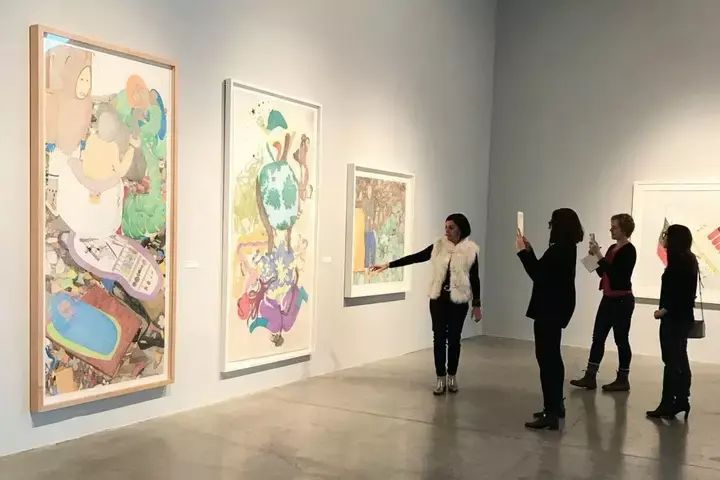
The expansion of Western art businesses into the Asian market has been extensively documented. Notably, Hong Kong has emerged as a leading hub for the art market, hosting all three major auction houses and attracting prominent galleries such as Gagosian, Hauser & Wirth, and David Zwirner. In recent years, the art scene in Seoul has also gained momentum, resulting in the expansion of Gladstone and Pace galleries to the city.
According to UBS and Art Basel's A Survey of Global Collecting in 2022, the import and export of art in Hong Kong in 2021 amounted to approximately $8.6 billion. Mainland China accounted for $4.9 billion of this figure, while Singapore accounted for $600 million.
Meanwhile, Asian galleries have also been expanding their operations to foreign markets, although such moves have received less media attention. For instance, Manila dealers have established a presence in New York, Tokyo galleries have opened in Shanghai, and Shanghai dealers have extended their reach to Singapore.
In 1950, Tokyo Gallery was established in the Japanese capital by Takashi Yamamoto. While showcasing works of Japanese artists like Kazuo Shiraga and Jiro Takamatsu, Yamamoto collaborated with Western galleries to feature renowned artists such as Yves Klein and Jackson Pollock. In the 1970s, following his visits to South Korea, he presented artists such as Park Seo-bo and Lee Ufan.
Sasaki, a representative of the gallery, noted that Japanese art has historically engaged in cultural exchanges with China and Korea. Yamamoto's visit to Seoul in the early 1970s introduced him to Korean monochrome painting, which led to the first show of Dansaekhwa in Japan in 1975.

Yukihito Tabata, the son of Yamamoto, continued the gallery's tradition of cultural exchange. He visited the seminal 1989 'China Avant-Garde' exhibition at the National Museum of China in Beijing, which prompted the gallery to showcase artists such as Xu Bing and Cai Guo-Qiang in the 1990s.
During his search for a large studio in Beijing, Tabata collaborated with Chinese artist Huang Rui. Ultimately, they both secured spaces in a decommissioned military factory complex located in Dashanzi, Beijing. This complex provided expansive industrial spaces that were suitable for artists to exhibit their installations.
In 2002, Beijing Tokyo Art Projects (BTAP) was established in this complex. At the time, it was not known that the Dashanzi factory complex would evolve into the 798 Art Zone, which now houses almost 200 galleries and prestigious institutions such as the UCCA Center for Contemporary Art.
A few years prior to the establishment of BTAP, Zheng Lin, a native of Hunan, was working as an art teacher in Bangkok. After discovering a lack of art galleries in the area, he launched Tang Contemporary Art in 1997 to address this gap.
According to Executive Director Vivian Har, the timing was perfect for Tang Contemporary Art. The Chinese art market was not yet fully developed, and Chinese art was relatively inexpensive. The gallery primarily sold to affluent immigrants, as wealthy Chinese individuals had moved to countries like Thailand, Malaysia, and Singapore. Additionally, the financial crisis at the time resulted in lower rent prices.

Lin visited Beijing frequently to lay the foundation for the gallery's opening in 2006 when the Chinese art market was rapidly expanding. As international galleries began to move into the 798 Art Zone, Beijing became the headquarters for Tang Contemporary Art. Presently, the gallery boasts three locations in the city, with the largest measuring approximately 3,000 square meters. In 2008, the gallery expanded to Hong Kong, taking advantage of the lower rents that resulted from the global financial crisis. The gallery has since upgraded to a Central District space designed by architect-collector William Lim.
Tang Contemporary Art is expanding globally, with plans to open a gallery in Singapore and possibly in New York or London. Other galleries, such as Can Yavuz's, are also expanding globally, with a space in Sydney and plans for a third space in Europe.


Comments